


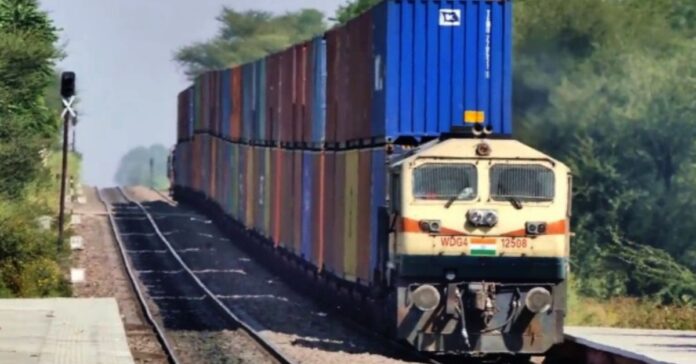
The National Rail Plan envisages that the share of freight traffic by rail should go up from current share of 27% to 45% by 2030. The construction of Dedicated Freight Corridors (DFCs) on the important high-density route is an important policy measure by Indian Railways to arrest the trend of falling market share of railways in the country and also will shift the advantage in favour of rail transport. DFC operation will bring-in efficiency in freight operation and enable rail tariff being more competitive because of its following operational/design features:
- Higher throughput per wagon and per train: Run Heavy Haul trains with overall load of 13000 tonne.
- Lower Energy Consumption: Reduce Operation and Maintenances Costs
- Reduction in Transit time: Reduce logistic cost of transportation and better utilization of Rolling stock
Moreover Indian Railway has taken number of multi-pronged strategy to increase its model share in freight segment which includes tariff rationalization and Tariff/freight incentive schemes which includes; diversification of freight basket, Liberalised Automatic Freight Rebate Scheme in Traditional Empty Flow Directions, Rationalization of Station to station rates policy, Rationalization of Merry-Go- Round, Concession in short Lead Traffic, Discount in freight to fly ash traffic booked in Open/flat Stock & covered wagons, Round trip charging for ultra-short lead (upto 50Kms) container traffic, Round Trip Traffic (RTT) Policy, Automobile Freight Train Operator Scheme (AFTO), Introduction of Cube Container for two wheeler traffic. A New ‘Gati Shakti Multi- Modal Cargo Terminal (GCT)’ policy has also been launched to facilitate development of cargo terminals on non-Railway land, as well as on Railway land (partially or fully) etc.
In addition, various other schemes have also been introduced to attract private investment in General Purpose Wagons, Special Purpose/High-Capacity wagons and Automobile carrier wagons etc.
The divestment of CONCOR to the extent of 30.8% is based on the cabinet committee on Economic Affair (CCEA) approval on 20.11.2019 which is an independent activity and without any relation to para (a) above.
The Master Circular on “Policy for Management of Railway Land” issued on 04.10.2022 permits setting up of Renewable power plants for exclusive use of Railways for a lease period of upto 35 years @ ₹1/- per square meter (sqm) per annum. Further, it permits Hospitals selected through a transparent policy and Kendriya Vidyalaya Sangathan for a lease period of upto 60 years @₹1/- per square meter(sqm) per annum.
This information was given by the Minister of Railways, Communications and Electronic & Information Technology, Shri Ashwini Vaishnaw in a written reply to a question in Lok Sabha.