


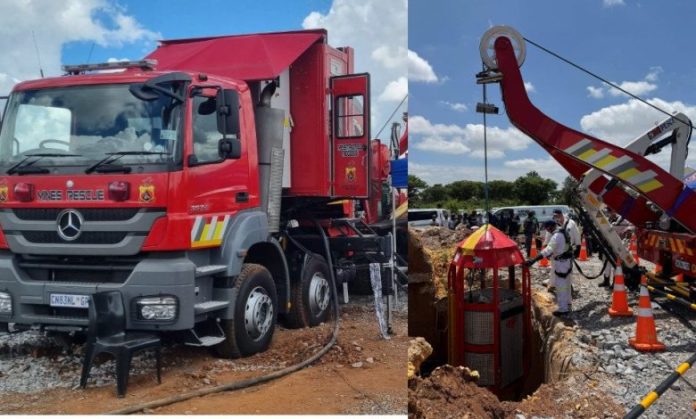
The rescue of 246 surviving illegal miners from the Stilfontein shaft in less than three days was enabled by a locally designed and manufactured Mobile Mines Rescue Winder (MMRW), equipped with world-first capabilities – including the ability to operate to a depth of 3 km.
“The MMRW performed flawlessly. Our MMRW demonstrated South Africa’s capacity to develop world-class solutions and contribute to a safer global mining future,” says Gauteng-based Tech Edge Group executive chairperson Russell Moore.
Tech Edge was responsible for the winder’s conception, design and manufacture.
On January 10, the Gauteng High Court ordered the rescue of illegal miners who had refused to exit Shafts 10 and 11 of the former Buffelsfontein Gold Mine, at Stilfontein, in the North West, for more than three months. The mine had closed in 2013 when its operations were no longer financially viable.
Mines Rescue Services (MRS) South Africa, the owner and operator of a Tech Edge MMRW, led the rescue operation.
According to Tech Edge MD Bannister Erasmus, he received a phone call just before 20:00 on January 12 from MRS CEO Mannas Fourie, asking Erasmus to have a team on site at the mine early the next morning.
Erasmus says the ground around the shaft had been somewhat cleared over the weekend and that, after on-site tests of the MMRW, the first cage of people was brought to the surface at about midday from a depth of 1.4 km.
The MMRW’s live camera feeds, from below the cage, inside the cage and on top of the cage, gave the surface team three different views of the interior of the shaft, while the communication system allowed messages to be relayed between the miners and the rescue team.
Although the cage’s recommended passenger count is six, Erasmus says most of the miners were so emaciated that about 11 people could be accommodated per trip.
Emergency workers were on site to treat the rescued illegal miners. Those healthy enough were arrested while the frail were sent to hospital under police guard.
Moore and Erasmus agree that, had it not been for the MMRW, which was designed to move on both national roads and extremely rough terrain, the rescue would not have been possible.
Despite site preparation being done over the weekend, the area remained rugged.
“For any other machine to have operated on the site, a concrete foundation would first have had to be laid,” Moore says.
Tech Edge support staff, including a mechanical and an electrical engineer, were on site 24/7 to monitor the rescue system.
“The immense time spent on research and development in bringing the MMRW to fruition paid off,” Erasmus says.
The rescue operation ended late on January 15.
The MMRW’s development was inspired by the 2010 Chilean mining disaster, where a lengthy rescue operation highlighted the need for more efficient and mobile rescue equipment.
When 33 miners were trapped in Chile’s San Jose mine after a massive rockfall, a standard Tech Edge winder was airlifted to the disaster site as part of Murray & Roberts’ response to the Chilean government’s call for assistance.
“Despite several countries with expert mining skills being involved in the rescue operation, it took 69 days to eventually retrieve the miners, who initially survived on emergency rations and water from a spring and radiators.
“The incident got me thinking about how a comparable situation would be handled in South Africa. I realised we needed to develop better equipment, and that this equipment would need the capabilities to go anywhere, and to do so quickly,” Moore says.
Once Moore’s ideas for the MMRW were fleshed out by Tech Edge’s team, he took the design to MRS, which commissioned the company to complete the MMRW project.
Moore explains that the winder needed to operate under extreme conditions and that human lives would depend on its flawless performance.
“To mitigate any risk, every component is designed with redundant systems,” he says.
The winder was tested and commissioned at one of the world’s deepest mines, Gold Fields’ South Deep Twin Shafts, near Johannesburg, in January 2021. It was then licensed by the Department of Mineral Resources and Energy (DMRE).
Subsequently, Tech Edge developed another winder for shallower mines, with 1 km depth capabilities, which MRS also acquired.
“A similar machine was delivered to a company sinking a diamond mine in Botswana,” Moore says.
Following the events in Stilfontein, Moore and Erasmus believe South Africa needs more licensed mobile rescue units.
To ensure rapid deployment, the rescue winder needed to be easily transportable, capable of navigating diverse terrains, and road-legal without requiring special permits.
In addition, it needed to be a self-contained system, with a power supply and sheave wheel deployment.
The winder drive and control systems are considerably more complex and sophisticated than similar machines because of the significantly increased depth of wind.