


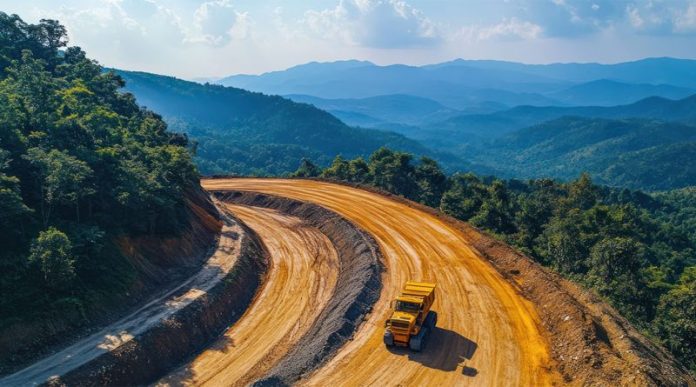
The Japanese government has committed $7 billion to develop the Nacala Corridor, a vital logistics route through Malawi, Mozambique and Zambia. The investment is designed to strengthen Japan’s access to critical minerals and create new regional infrastructure capacity, placing Sovereign Metals’ Kasiya project in a stronger strategic position on the global resource map.
The corridor upgrade aims to eliminate transport bottlenecks and enhance regional trade and resource flows. For Sovereign Metals, which controls the world’s largest known deposit of natural rutile and one of the largest flake graphite resources, the announcement signals improved economic viability for its Kasiya project located in central Malawi.
The commitment was announced during the Tokyo International Conference on African Development, where Japanese Prime Minister Shigeru Ishiba underscored the importance of building regional partnerships to stabilise mineral supply chains. This government-level backing positions the corridor and its linked mining projects as part of Japan’s national interest strategy.
Rail and port enhancements reshape export potential
The Nacala Corridor initiative includes capacity expansion and upgrades to rail, road and port infrastructure. A direct link to the deepwater Port of Nacala is expected to cut transport costs, reduce lead times and offer reliable year-round shipping to Asia, Europe and other global destinations.
The corridor also holds significance for landlocked nations in the region, particularly Malawi and Zambia, which have historically faced infrastructure gaps that limit export competitiveness. Malawi’s access to global mineral markets has relied on fragmented road networks and outdated rail infrastructure. Japan’s intervention changes that dynamic by enabling integrated, high-volume transport across three countries.
Sovereign Metals has already signaled plans to build a 6 km rail spur from its planned processing plant to the existing corridor. This connection is expected to be central to its upcoming definitive feasibility study and could represent a material improvement in the company’s capital and operating cost structures.
Strategic resource security drives Japan’s investment
Japan’s renewed interest in Africa’s logistics infrastructure is underpinned by its search for stable supplies of key industrial minerals. Rutile, a natural source of titanium feedstock, is used in aerospace, defense and high-performance engineering applications. Graphite is increasingly vital for battery production, particularly in electric vehicles.
Toho Titanium, a major Japanese metals company, has confirmed that Kasiya’s natural rutile meets technical specifications for high-grade titanium metal production. This independent validation supports Sovereign’s claims about the project’s quality and relevance to international supply chains.
In recent months, trade policies and critical minerals strategies have intensified global interest in secure and diversified supply. Japan’s $5.5 billion through the Enhanced Private Sector Assistance for Africa and $1.5 billion in direct investment via its development agency mark a coordinated effort to futureproof its access to essential raw materials.
The corridor’s modernisation is expected to improve load handling, rail reliability and intermodal integration. For Kasiya, which will rely on low-cost bulk freight to deliver its materials to port, this translates directly into project bankability.
New infrastructure may catalyse broader economic shifts
While Sovereign Metals is a direct beneficiary, the impact of the corridor’s upgrade extends further. Regional copper and cobalt producers in Zambia stand to gain from the improvements, and increased trade flow may support agri-logistics and fertiliser imports.
With enhanced infrastructure in place, countries like Malawi could also attract downstream investment. Mineral processing, once seen as logistically impractical in the interior, could become more viable with reliable power, water and export connections.
In parallel, regional governments may experience fiscal benefits from increased royalties and export revenues. Japan’s investment comes at a time when several African nations are reevaluating their mineral policies to favour in-country value addition and long-term sustainability.
Sovereign Metals now has a clearer pathway to global markets, reducing one of the major risks in developing large-scale critical mineral projects in landlocked nations. The presence of committed, high-level international support also improves the investment profile of projects like Kasiya, which depend on multilateral coordination.