


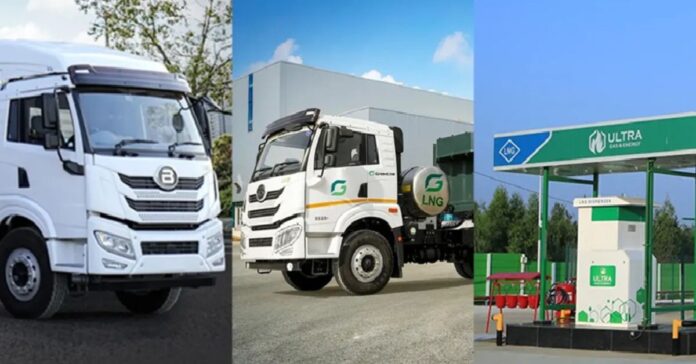
Essar Group’s green mobility arm is preparing a large-scale push into low-emission freight, with plans to deploy up to 30,000 LNG- and electric-powered trucks across India, backed by a nationwide network of alternative fuel and charging hubs.
Company officials said the programme, one of the largest clean freight initiatives proposed in the country, aims to cut nearly one million tonnes of carbon dioxide emissions annually from road freight, a sector that remains among India’s most carbon-intensive.
At the core of the strategy is a vertically integrated model that links vehicle manufacturing, fleet operations and fuelling infrastructure. Essar believes this end-to-end approach will help overcome two of the biggest hurdles facing clean freight adoption in India: high upfront vehicle costs and the lack of reliable refuelling and charging infrastructure.
The platform brings together Blue Energy Motors, which manufactures LNG and electric trucks; GreenLine Mobility Solutions, which operates the clean trucking fleet; and Ultra Gas & Energy (UGEL), which is building the supporting LNG, EV charging and battery-swapping network.
GreenLine currently operates more than 800 LNG-powered trucks serving sectors such as steel, cement, FMCG and chemicals. According to the company, the fleet has logged over 70 million kilometres and reduced carbon emissions by nearly 20,000 tonnes. Each 55-tonne LNG truck can haul up to 40 tonnes of cargo and travel roughly 1,200 km on a single tank.
The expansion is being supported by a recent USD 275 million equity raise, which included a USD 20 million investment from Zerodha co-founder Nikhil Kamath. The funding will be used to deploy over 10,000 additional LNG and electric trucks in the near term and to accelerate the rollout of around 100 LNG refuelling stations, EV charging points and battery-swapping facilities.
The programme follows a dual-technology strategy: LNG trucks will be used primarily for long-haul freight, where energy density and range are critical, while electric trucks will be deployed for short-haul and urban logistics, where electrification offers higher efficiency and lower operating costs. Charging and battery-swapping systems are being integrated into multi-fuel hubs to maximise vehicle utilisation and minimise downtime.
UGEL currently operates LNG refuelling hubs along key industrial corridors and plans to scale this to a nationwide network of 100 stations, covering about 85% of India’s long-haul freight routes. The expansion, backed by an investment of around Rs 900 crore, is underway across several states including Gujarat, Maharashtra, Tamil Nadu, Rajasthan, Haryana, Punjab, Karnataka, Odisha, Chhattisgarh and Jharkhand.
Industry analysts say Essar’s integrated, scale-driven approach could accelerate adoption of cleaner freight technologies, but note that sustained policy support and long-term private investment will remain essential if India is to decarbonise logistics at scale without constraining economic growth.
With control across the value chain, Essar is positioning itself as a key player in India’s freight decarbonisation push, aiming to deliver cleaner mobility solutions while improving efficiency across the logistics ecosystem.