


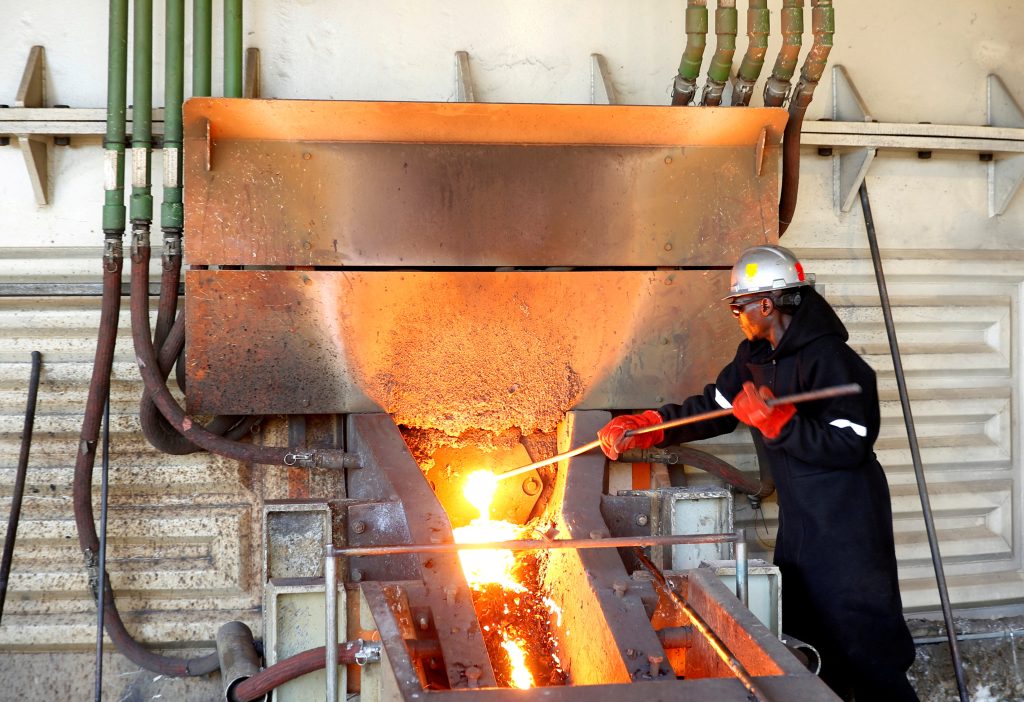
Global miners operating in Zimbabwe will have to pay some of their royalties in refined metal rather than cash, President Emmerson Mnangagwa wrote in a newspaper on Sunday, as the country struggles to benefit from demand for its resources.
Zimbabwe has abundant reserves of minerals such as gold and platinum group metals (PGM), but power supply problems, a lack of ancillary industries to support mining and currency fluctuations have prevented it from profiting from a resource boom.
“Starting this October, government now requires that part of these royalties come as actual refined mining product,” Emmerson Mnangagwa wrote in a column in The Sunday Mail.
None of the companies contacted by Reuters immediately responded to a request for comment.
The policy will target four main minerals – gold, diamonds, PGMs and lithium – he said.
Mnangagwa said the aim was to build a national reserve of precious metals and critical resources for the benefit of the current population and future generations.
“We cannot, as the present government, and as the current generation, run and manage finite resources profligately, without any regard for generations yet and sure to come!” he wrote.
Leading South African companies such as Impala Platinum and Anglo American Platinum are among those that extract PGMs in Zimbabwe.
Gold companies, including Johannesburg-listed Sibanye Stillwater and London-listed Caledonia Mining, also operate there.
In addition, Chinese miners are involved in lithium mining in Zimbabwe with the potential to make it Africa’s biggest lithium producer, analysts say.
Economist Tinashe Murapata warned the move could cause inflation to go up.
“Zimbabwe Revenue Authority (Zimra) revenues will dwindle. I think cabinet doesn’t understand what monetary policy is or what central banking is. And they don’t want to admit that they don’t know. What the president is proposing is inflationary,” Murapata tweeted.
“In monetary economics, central banking sits outside of the government of Zimbabwe. Central banks build reserves by buying assets through the market. This is done for a reason, since the same asset must be easily liquidated. Reserves must be liquid foremost. If Zimra has a shortfall, expect inflation.”