


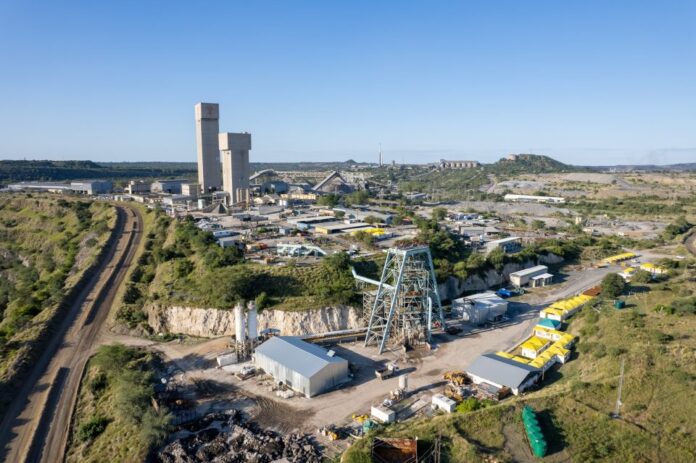
The Murray & Roberts Cementation shaft sinking team responsible for delivering a new ventilation shaft at Palabora Copper Mine (PMC) recently celebrated the achievement of a major milestone – the reaching of the 800 m mark. This represents two-thirds of the shaft’s final depth of 1 200 m.
The ventilation shaft forms part of the copper producer’s Lift II project which will extend mine life by more than 15 years. Originally an open pit mine, the Palabora mine transitioned to being an underground block cave operation in the early 2000s when Lift 1 was commissioned.
PMC is located within Phalaborwa in the Limpopo province in South Africa and the extension of the life of mine will increase shareholders’ value and sustain jobs and livelihoods of the surrounding communities. The mine has also initiated several wildlife management programmes to minimise the impact of its operations on the environment as well as promote the harmonious co-existence of people, industry and wildlife.
Murray & Roberts Cementation’s contract to sink the 8.5 m diameter shaft was awarded in February 2019. According to Fred Durand, the company’s senior project manager, the shaft sinking is currently making good progress, with 40 or more lined metres of advance being completed on average each month.
“Shaft sinking operations should be completed by the end of this year with final handover of the shaft to our client, PMC, taking place at the end of the first quarter of 2024,” he says.
Ground conditions have presented a challenge on the project. This has resulted in the shaft lining being taken right down to the blasted face, says Jas Malherbe, Murray & Roberts Cementation’s on-site project manager.
“Normally, we would line the shaft to within 12 to 18 m of shaft bottom and support the sidewalls temporarily with split sets and mesh,” he explains. “In practice, this did not prove viable, prompting us to change our approach. The method we’ve adopted is unconventional but has proven to be highly effective.”
Drilling is undertaken by two twin-boom Komatsu electro-hydraulic jumbo drill rigs. These are slung down the shaft from surface and nested in the four-deck stage for drilling the shaft bottom, a procedure which is repeated for each 48-hour blast-to-blast cycle.
Another key piece of equipment is a Komatsu excavator with a 0.3 m3 bucket. It is lowered from surface through the stage to shaft bottom and is used for lashing. All the waste rock is loaded into a 11 tonne kibble which transports it to surface.
The ground conditions at the shaft are such that blasting tends to produce large rocks, which can be difficult to handle. “We break these up using the excavator which has a quick coupler which allows it be fitted with a hydraulic breaker within a few minutes,” says Malherbe.
The methods being used at Palabora are based on the Canadian shaft-sinking method that Murray & Roberts Cementation has pioneered in South Africa at its Venetia mine contract for De Beers Group.
“We have adapted the method because of the very different conditions we’re facing but many elements remain the same or are very similar,” says Malherbe. “In particular, the high degree of safety offered by the Canadian method has not in any way been compromised.”
The number of Murray & Roberts Cementation personnel deployed per shift is 25. The total labour complement on site is currently just over 120 people, 46 % of them recruited from local communities.
Murray & Roberts Cementation has a vigorous CSI programme running in conjunction with its contract. The programme is being implemented in close association with PMC and has mainly focused on supporting local schools in the Phalaborwa area with infrastructure such as ablution facilities, fences, water storage tanks and boreholes.
“In addition, we have trained nearly 80 youths from local communities at our Bentley Park Training Academy near Carletonville,” says Durand. “Another 20 are currently undergoing training. This programme is giving them skills which are in high demand in mining and which could lead to them securing permanent employment within the mining industry.”