


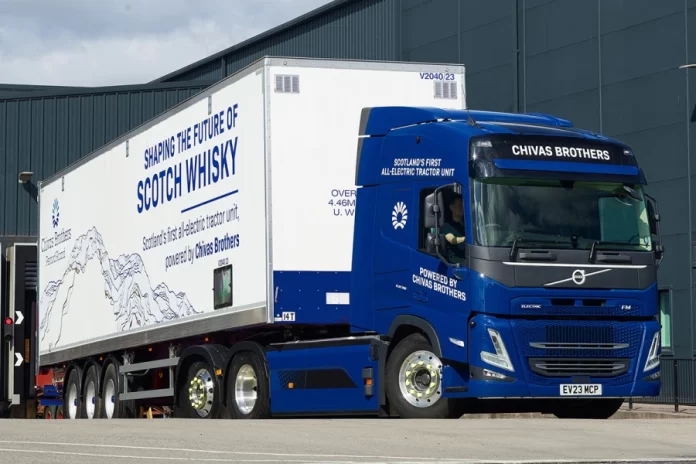
Scotch whisky producer, Chivas Brothers, makers of Chivas Regal and The Glenlivet, has announced the delivery of Scotland’s first all-electric tractor unit, a Volvo FM Electric 6×2 pulling a tri-axle box van trailer and operating at up to 44 tonnes gross vehicle weight.
Specified for the purposes of transporting Scotland’s biggest export, Scotch whisky, the truck is capable of hauling approximately 24 tonnes of whisky per journey and will cover between 250-300 miles per day, clocking up at least 62,000 miles per annum.
It forms the basis of a first-of-its-kind pilot programme, to be managed by McPherson’s, Chivas Brothers’ long-term haulage partner, designed to push the truck to its full capabilities and help the industry understand how electrification can benefit heavy trucks in the future. This truck alone will cut Chivas Brothers’ carbon emissions by 155 tonnes per annum, part of the business’ commitment to reducing its overall carbon footprint by 50% by 2030.
The pilot is expected to run for an initial two-year period, from which the truck’s range, uptime, safety and operational ease of use will be assessed to determine the viability for a wider rollout across Chivas Brothers’ transport fleet in the future.
“We are a proudly Scottish business and feel a deep responsibility to further the sustainability agenda, not only in whisky but for Scotland at large. While it is a true first for both, enabling us to progress towards a sustainable future for Scotch, innovating in electrification stands to benefit industries well beyond our own,” says Jean-Etienne Gourgues, Chairman and CEO of Chivas Brothers.
“We passionately believe that creating the highest-quality whisky should not mean compromising on sustainable and responsible business practice,” adds Jean-Etienne. “This pilot will show us what is possible through long-term collaboration with partners who recognise the importance of our sustainability vision and remain steadfast in innovating to realise our shared success.”
“Chivas Brothers and McPherson’s are setting a fantastic example by becoming early-adopters of a new generation of heavy truck which meets the demands from society for dramatic cuts in CO2 emissions,” says Neil Park, Managing Director of Volvo Truck and Bus Centre North & Scotland. “It’s our mission to support customers in making the switch to electrification, and we are looking forward to growing this collaboration together.”
“Scotland’s whisky industry is hugely important to our economy, especially in rural and island communities. It is also innovative and creative, and this ambitious project is a prime example of the continued progress that our beloved whisky sector is making to achieve net zero emissions in their operations by 2040,” explains Rural Affairs, Land Reform and Islands Secretary Mairi Gougeon.
“Whisky is enjoyed by millions across the globe, but it is crucial that we work toward ensuring that the future of our most popular export is both carbon neutral and sustainable. I hope that companies across all sectors will be inspired by the bold approach shown by Chivas Brothers and Volvo Trucks. Similar bold and urgent action will be needed across all sectors in order to secure a net zero future for Scotland,” Gougeon adds.
This is a milestone in Chivas Brothers’ net-zero journey, which implements innovative technologies to drive sustainable change. The producer has already rolled out other sustainable transport solutions across its operations, including a fleet of six circular bio-gas trucks and 19 site-based shunt vehicles, approximately half of which are currently trialling hydrotreated vegetable oil (HVO) fuel.
The all-electric tractor unit will operate from McPherson’s local depot, where a 43kW charger has been installed. This site is situated adjacent to Chivas Brothers’ world-class Kilmalid facility, from where it will embark on its inaugural journey this coming week.
The Volvo FM Electric features three electrical motors, generating an output of 666 hp and 2,400 Nm of continuous torque, paired with Volvo’s renowned I-Shift gearbox to deliver a smooth and ultra-quiet in-cab driving experience.
The truck has been specified to meet the needs of a specific application, being equipped with five batteries, which allows for a range of up to 250km dependent on operational, driving and environmental conditions. When specified with the maximum six batteries, an FM Electric is typically capable of travelling up to 300km on a full charge.