

As global trade tensions, tariffs, and protectionist policies reshape supply chains, companies are rethinking where and how they source. Once a secondary option in the China+1 strategy, Vietnam is now emerging as a frontline manufacturing and logistics hub in Southeast Asia.
“Over the past decade, Vietnam has evolved into a strategic pillar of global supply chains,” said Laurence Cheung, Managing Director at DHL Global Forwarding Vietnam. “It is no longer a tactical alternative but a fully capable manufacturing and logistics base, with strong production, trade connectivity, and infrastructure.”
Rapid Export Growth and Trade Connectivity
Vietnam’s exports surged 14.3% in 2024, reaching over US$405 billion, driven by trade agreements like the CPTPP and RCEP, which provide preferential access to markets representing more than 30% of global GDP.
Companies are investing in Vietnam’s local logistics ecosystem, workforce development, and long-term infrastructure, signaling a shift from short-term diversification to strategic anchoring. Vietnam now exports industrial machinery, high-tech products, solar panels, semiconductors, modular construction units, and fabricated steel.
Project Cargo and Industrial Expansion
Industrial and project cargo is expanding rapidly. Modular building firms like TLC Modular manufacture in Vũng Tàu and ship complete modules from Phú Mỹ worldwide. Other sectors — including shipbuilding, renewable energy components, and heavy machinery — are also gaining momentum.
“Project cargo handling capacity is strengthening year-on-year,” said Grant Bell, Operations Director at NMT Projects. “Deep-water ports such as Phú Mỹ and Cai Mep–Thi Vai are supporting heavy-lift and oversized cargo on par with regional competitors.”
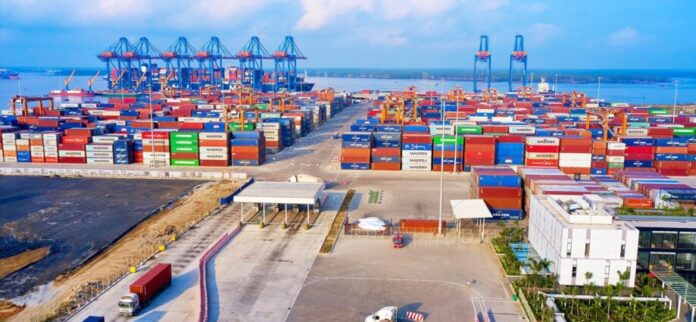
The south of Vietnam, particularly the Vũng Tàu–Phú Mỹ corridor, is leading growth thanks to industrial clustering, deep-water port access, and multimodal logistics solutions.
Infrastructure Investments Fuel Growth
Vietnam’s government is investing heavily in infrastructure:
-
Long Thanh Airport near Saigon
-
North–South Expressway
-
Rail links, including the Lao Cai–Haiphong line
-
Port upgrades at Cai Mep–Thi Vai and Phú Mỹ
With US$36 billion earmarked this year for transport, ports, and digital logistics systems, Vietnam is positioning itself as a regional logistics leader by 2030.
Logistics as a Strategic Differentiator
Experts note that Vietnam’s logistics capability now defines its competitiveness. Digital customs, ESG compliance, and end-to-end cargo traceability are increasingly demanded by global clients.
“Manufacturing capacity alone is no longer enough,” said Bell. “Vietnam’s ability to move complex cargo efficiently and transparently is the differentiator.”
Although challenges remain — such as high logistics costs, port congestion, and limited hinterland connectivity — careful planning, multimodal transport, and experienced logistics partners are helping companies navigate these hurdles.
Outlook: Resilient and Strategic
Vietnam is not seeking to replace China but to establish itself as a sourcing and logistics power in its own right. Its trade connectivity, political stability, and growing industrial base make it an increasingly core part of global sourcing strategies, particularly for high-value, project, and renewable energy cargo.
“Firms are embedding Vietnam into their long-term sourcing strategies,” said Schwenke, Regional Director at Rhenus Air & Ocean. “It is resilient, capable, and poised for sophisticated supply chain growth.”
The impact of tariffs on sourcing and project timelines will be a key discussion point at Breakbulk Americas 2025, including a panel moderated by UTC Overseas’ Diana Davila.