


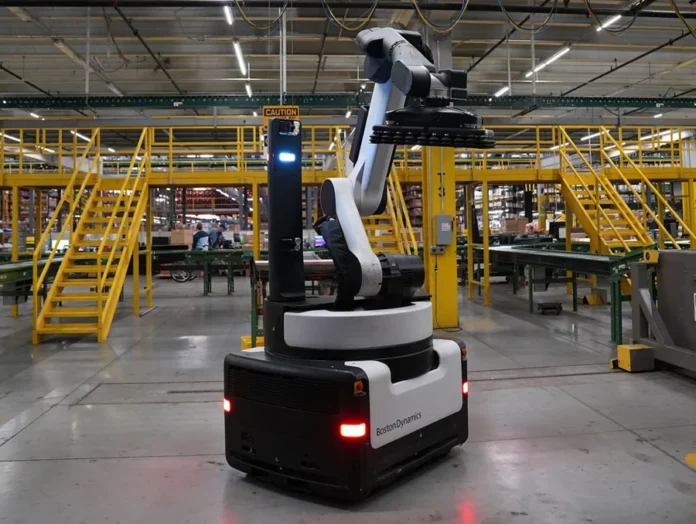
Inbound logistics remains one of the most labour-intensive and physically demanding nodes within global supply chain networks. Mobile robotics pioneer Boston Dynamics – a wholly-owned subsidiary of Hyundai Motor Group – has unveiled Stretch Gen 2, a next-generation autonomous mobile robot (AMR) specifically designed for warehouse activities, including trailer unloading.
Built upon operational data harvested from more than 100,000 industrial operating hours and tens of millions of handled cases, this second-generation platform introduces hardware, electrical, and structural upgrades designed to maximise unit availability, and improve dock-door throughput.
Hardened Hardware for High-Velocity Material Handling
The operational reality of trailer unloading involves navigating unstructured environments, uneven dock floors, and shifting cargo loads. To withstand these harsh physical conditions, Boston Dynamics has re-engineered Stretch’s core electrical and mechanical architectures. The robot now features heavy-duty, automotive-grade connectors specifically rated to withstand the continuous, high-torque vibrations of rapid box grasping.
“With Gen 2, we focused on the things that actually took robots offline in the real world. We made it tougher, we made it simpler to service, and we made sure it keeps getting better long after it’s deployed,” says Brian Donnelly, Vice President & General Manager of Logistics Robotics at Boston Dynamics.
Redefining On-Site Maintainability and Fleet Diagnostics
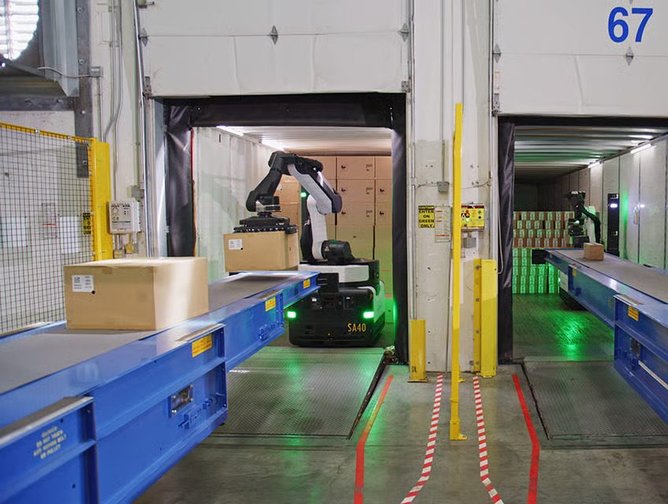
In modern fulfilment centers, every minute of robotic downtime creates a backlog at the receiving dock. Stretch Gen 2 addresses this by utilising a highly modular design that simplifies routine maintenance. By standardising high-strength fasteners and simplifying mechanical sub-assemblies, facility operators can perform rapid component swaps without relying on specialised external robotics field technicians.
This simplified maintenance framework is supported by an upgraded onboard computing platform running advanced, real-time diagnostics. The computing system enables over-the-air software updates that continuously improve case detection, spatial modelling, and motion planning across an entire warehouse fleet.
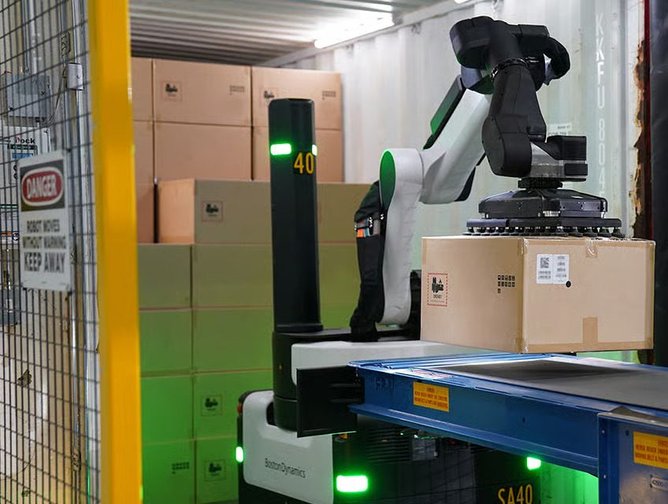
To safely handle unpredictable case configurations, Stretch Gen 2 features an upgraded vacuum-based gripper head integrated with sensitive pressure valves and advanced spatial array sensors. These sensors detect case shifts in real time, adjusting the robot’s approach angle and vacuum seal to prevent drops or carton punctures.
-
1,000 cases per hour throughput: Processing mixed-SKU container freight and variable-weight cartons autonomously under real-world dock conditions.
-
81% internal cabling reduction: Eliminating a half-mile of internal wiring to remove common electrical failure points and reduce maintenance overhead.
-
1-hour swerve drive replacement: Reducing a critical drive-unit maintenance procedure from 24 hours down to less than 60 minutes.
-
Dual-shift battery endurance: Operating continuously across two consecutive warehouse shifts on a single charge, supported by a 75-minute fast-charging cycle to 90% capacity.
-
Zero-programming vision deployment: Utilising a pre-trained machine-learning model that instantly recognises, segments, and picks diverse packaging types from day one.
Hyundai investment in robotics hub
Hyundai acquired full ownership over Boston Dynamics in August 2026, purchasing SoftBank’s remaining shareholding. The acquisition is in line with Hyundai’s strategic focus on robotics.
Hyundai announced plans at CES 2026 in Las Vegas earlier this year that production of Boston Dynamics’ Atlas robot, an enterprise grade humanoid robot that can perform a wide array of industrial tasks, from material handling to order fulfilment, was beginning at its Boston manufacturing hub. Hyundai’s Robotics Metaplant Application Center (RMAC) and Google DeepMind were the initial customers for Boston Dynamics’ Atlas model.
In April 2025, Hyundai announced that it was allocating a proportion of a US$26bn investment to build a Robotics Innovation Hub in Georgia. The leading edge robotics facility will have an annual capacity of 30,000 units, and will act as a US hub for design, manufacturing, testing, and deployment.