


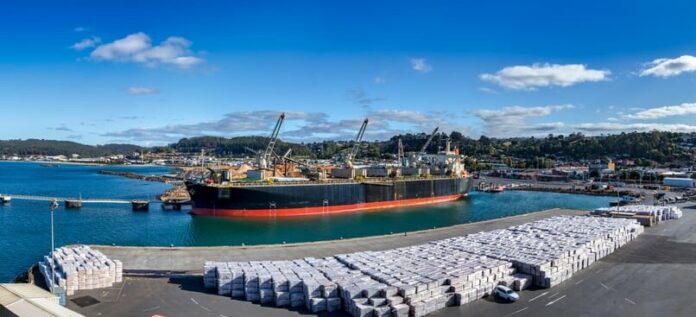
TasRail’s mobilisation on its newest shiploader at the Port of Burnie is on track, with construction to begin in January 2023 when the components arrive.
The fabrication of the new infrastructure is well underway at COVA Haywards in Launceston and The Engineering Company at Somerset, supported by quality assurance from the Tasmanian Minerals and Energy Council.
Construction is set to commence after late January 2023, following the arrival of components.
TasRail’s new shiploader will load at twice the speed of the current facility and, when combined with the additional 15,000t storage capacity at the Port, this step-change in scale is attracting significant interest from the mining sector.
The project is supporting 140 local Tasmanian jobs in design and construction is on track for commissioning in mid-2023.
The Burnie Port Ship-loader is just one element of Tasmania’s $5.6 billion infrastructure program designed to support jobs, and build safer and more connected communities.
The increased loading speed and capacity of the new facility and its seamless connection to TasRail’s freight rail network has already created interest in the mining and mineral processing industries.
The largest customer of the facility, Tas Mines, has signed a Memorandum of Understanding with TasRail to undertake a joint feasibility study with TasRail to shift its freight task to the Port from road to rail.
Tas Mines shipped 260,000t of magnetite from the mine to the Port in 2021.
With the Australian Government’s commitment to an $18 million bulk minerals loading hub on TasRail’s Melba Line, the bulk minerals industry will be provided with new and exciting storage and logistics options – with rail connections being foremost among these.
While the feasibility is to be determined, the shift to rail would provide the potential to remove 6,500 truck movements each way annually on current volumes alone and provide a seamless rail to ship logistics train for the Hampshire-based Tas Mines.
This is one example of the potential of the new bulk minerals ship-loader and expanded storage facility at the Port of Burnie.
In the previous financial year, TasRail ship-loaded 650,000t of zinc, lead, and high-grade iron ore through the existing facility, which was just one ship-load short of a record.
The Budget and Forward Estimates includes $4.85 billion in investments by the General Government Sector, with a further $736.9 million in support investment by other Government businesses.