


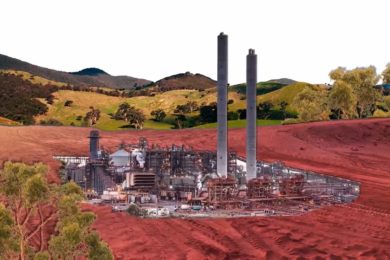
Rio Tinto and Sumitomo Corporation are to build a first-of-a-kind hydrogen plant in Gladstone, Australia, as part of a A$111.1 million ($74.6 million) program aimed at lowering carbon emissions from the alumina refining process.
The Yarwun Hydrogen Calcination Pilot Demonstration Program received the green light after a A$32.1 million co-funding boost from the federal government’s Australian Renewable Energy Agency (ARENA).
The program is aimed at demonstrating the viability of using hydrogen in the calcination process, where hydrated alumina is heated to temperatures of up to 1,000°C.
It involves construction of a hydrogen plant at the refinery and the retrofit of refinery processing equipment. If successful, the program could pave the way for adoption of the technology at scale globally, Rio says.
Rio Tinto Aluminium Pacific Operations Managing Director, Armando Torres, said: “This pilot plant is an important step in testing whether hydrogen can replace natural gas in Queensland alumina refineries. At Rio Tinto we have put the energy transition at the heart of our business strategy, and this is one of the ways we’re working towards decarbonising our operations.
“We are proud to be developing this new technology here in Gladstone, in partnership with Sumitomo Corporation, and with support from ARENA.”
The project will consist of construction of a 2.5 MW on-site electrolyser to supply hydrogen to the Yarwun refinery and a retrofit of one of Yarwun’s four calciners so it can operate at times with a hydrogen burner.
The trial is expected to produce the equivalent of about 6,000 t/y of alumina while reducing Yarwun’s carbon dioxide emissions by about 3,000 t/y.
Converting the entire plant to green hydrogen could reduce emissions by 500,000 t/y, Rio estimates, the equivalent of taking about 109,000 internal combustion engine cars off the road.
Construction will start in 2024. The hydrogen plant and calciner are expected to be in operation by 2025.
Sumitomo Corporation will own and operate the electrolyser at Yarwun site and supply the hydrogen to Rio Tinto directly. The electrolyser will have a production capacity of more than 250 t/y of hydrogen.
Sumitomo Corporation Energy Innovation Initiative Director, Seiji Kitajima, said: “We are excited to be delivering this hydrogen project together with Rio Tinto as our long-term partner with the support of ARENA.
“Demonstrating real-world applications of hydrogen in industrial settings with motivated partners is essential to reducing carbon emissions and working toward our company’s vision of achieving carbon neutrality by 2050. Through this demonstration, Sumitomo Corporation aims to venture into the commercialisation project to contribute to Rio Tinto’s decarbonisation.
“Sumitomo Corporation is proud to be working on yet another hydrogen project in Australia and contributing to Australia’s own emission reductions goals.”
Rio Tinto says it is committed to achieving net-zero emissions by 2050 and has targets to reduce Scope 1 & 2 emissions by 50% by 2030 from 2018 levels.