


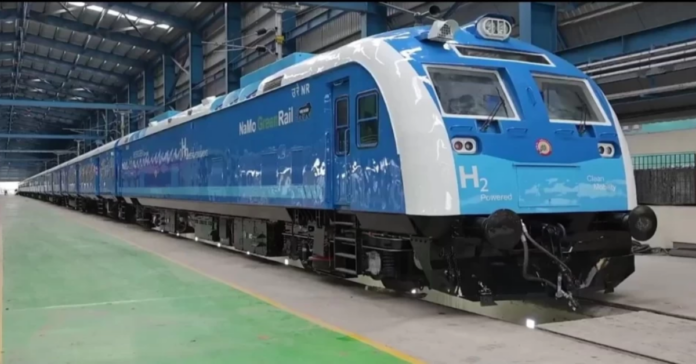
India’s first hydrogen‑powered train has successfully completed a trial run on the Jind–Sonipat route in Haryana, marking a milestone in the railways’ shift toward low‑emission traction. The indigenous trainset, developed and tested by Indian Railways’ manufacturing and technical units, ran through a series of performance checks including speed trials, braking and stability tests, and hydrogen fuel‑system validation.
Trial performance and technical notes
The train attained its target speeds during the trial and completed prescribed oscillation and safety assessments required before certification for regular operations. Hydrogen fuel cells onboard convert hydrogen to electricity, emitting only water vapour at the point of use, which helps reduce greenhouse gas and particulate emissions on non‑electrified routes. The trial also evaluated onboard storage, refuelling readiness, and integration with existing railway signalling and safety systems.
Manufacturing and collaboration
The trainset was developed in India with contributions from domestic workshops and technology partners, demonstrating strengthened local capabilities in alternative‑fuel rolling stock. The project followed regulatory and safety clearances for prototype trials and is part of broader efforts to diversify motive power where electrification is not yet feasible or as a complementary low‑carbon option.
Operational implications
If cleared for regular service after remaining tests and approvals, hydrogen trainsets could offer a viable zero‑emission alternative for regional and branch lines, reducing dependence on diesel on non‑electrified corridors. Operators would however need to establish hydrogen production and refuelling infrastructure, staff training, and maintenance regimes to ensure safe, cost‑effective operations at scale.
Policy and sustainability context
The trial aligns with national targets to reduce transport emissions and demonstrates a practical step toward decarbonising rail transport while leveraging indigenous manufacturing. Adoption at scale will depend on lifecycle cost comparisons with electrification and diesel, availability of green hydrogen, and supportive policy for infrastructure roll‑out.
Illustrative example
A hypothetical regional deployment could replace several daily diesel multiple unit services on a 150‑km corridor with hydrogen trainsets, cutting local emissions and improving air quality while requiring a single refuelling depot at a terminus.